

Attic Insulation
Premium Attic Insulation Services
Lower your energy bills and protect your roof with professional blown-in fiberglass insulation tailored for Michigan and Ohio homes.
BBB Rating: A+
Proven excellence in service and customer satisfaction.
Energy Savings & Comfort Commitment
Lowering your monthly bills while keeping your home cozy.
Expert Certified Installation
Trained crews who treat your attic with precision and care.
Fully Licensed & Insured
Total peace of mind for your home and investment.
Attic Insulation Overview
We believe your attic is more than just storage space—it’s the frontline of your home’s energy efficiency and roof protection. Our high-performance attic insulation solutions are designed to keep your home comfortable while extending the life of your entire roofing system.
Lower Your Energy Bills
Stop heating the outdoors. Proper blown in attic insulation prevents conditioned air from escaping through your roof, significantly reducing your monthly heating and cooling costs year-round.

Year-Round Home Comfort
Eliminate drafts and seasonal hot spots. Our precision insulation ensures a consistent temperature throughout your home, keeping you warmer in the freezing Midwest winters and cooler during humid summers.
Prevent Costly Roof Damage
Insulation isn’t just for comfort—it’s for protection. By regulating attic temperatures, we help prevent ice dams and stop your rafters from expanding and cracking, saving you from expensive structural repairs.
Our Process: Precision Attic Insulation
When you choose Victors Home Solutions, you’re getting a professional, detail-oriented process that ensures your attic performs at its best.
Free 21-Point Inspection
We start by assessing your current insulation levels, identifying air leaks, and checking for proper ventilation to ensure your attic is healthy from the start.
Custom Material Selection
We use what we believe is the best insulation for attic performance—premium blown-in fiberglass. We’ll help you determine the right depth to reach your target R-value, with R-49 being our standard recommendation for maximum efficiency.
Preparation & Baffling
Before we blow in any material, we install baffles to ensure your soffit vents remain clear. This maintains vital airflow and prevents moisture buildup under your roof deck.
Precision Blown-In Installation
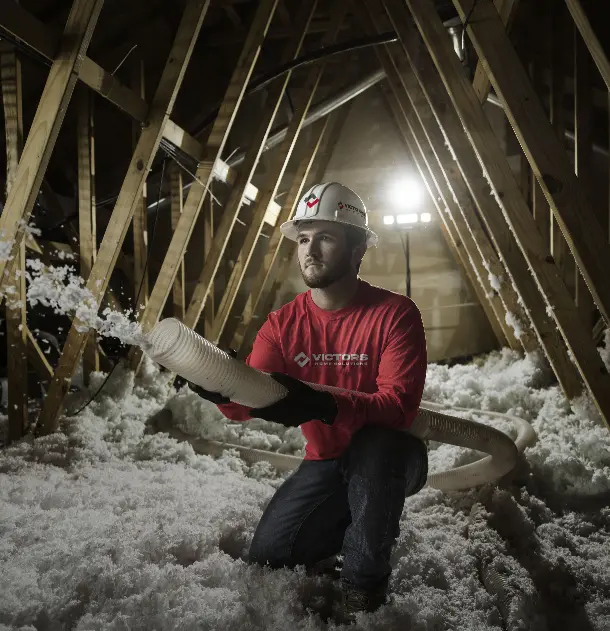
Our expert crews use specialized equipment to distribute fiberglass attic insulation evenly across every corner of your attic, reaching a depth of R-38 up to R-60 for maximum thermal resistance.
Thorough Cleanup & Quality Check
We treat your home like our own. Once the job is done, we perform a complete cleanup and a final quality check to ensure your attic is sealed, vented, and ready for the seasons ahead.
Get a Free EstimateWhat Our Customers Are Saying
Don’t just take our word for it. Here’s what homeowners say about their roof replacement experience with Victors Home Solutions.

A High-Performance Insulation System
A well-insulated attic is a system of layers working together. We don’t just add fluff; we build a barrier that protects your home and your investment.
Premium Blown-In Fiberglass
Unlike cellulose, our fiberglass insulation doesn’t settle over time, is naturally fire-resistant, and won’t absorb moisture, maintaining its R-value for decades.
Optimized R-Value (R-38 to R-60)
The R-value measures how well insulation resists heat flow. We recommend an R-49 minimum for our region to provide a true thermal break between your living space and the outdoors.
Proper Ventilation & Baffling
Insulation only works if the attic can breathe. We install baffles to keep your vents open, allowing air to circulate while the insulation keeps the heat where it belongs.
Structural Protection
By preventing heat from reaching your roof deck, our insulation stops your rafters from expanding and contracting excessively, which prevents structural cracking and preserves your roof’s integrity.
Understanding Attic Insulation Cost
We believe in transparency. Your attic insulation cost is an investment that pays for itself over time through lower utility bills. Factors that influence your estimate include:
- The total square footage of your attic space.
- Current insulation levels (if any) and whether removal is required.
- Your desired R-value (R-49 vs R-60).
- Additional air sealing or ventilation repairs needed to ensure system performance.
Ready To Lower Your Energy Bills?
Speak with one of our specialists to see how much you could save with premium attic insulation.
Get Your Free 21-Point Attic Inspection Today
"*" indicates required fields